Here’s something I wrote for The Guardian on cooking shows.
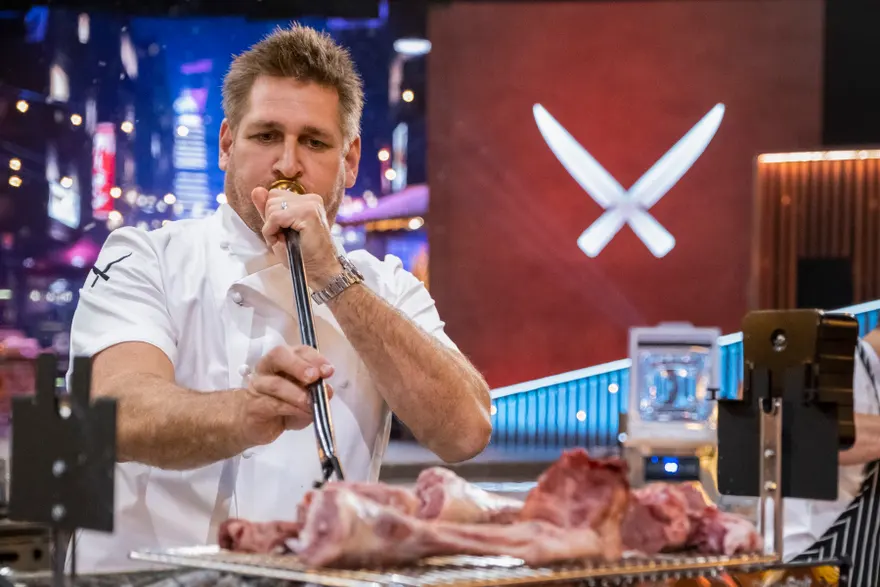
It’s battle time on Netflix’s cooking competition Iron Chef: Quest for an Iron Legend, and celebrity chef Curtis Stone is facing challenger Mason Hereford. Their task? To cook five courses in 60 minutes with the surprise ingredient (lamb). Each dish must be inspired by street food and cooked by fire.
“Allez cuisine!” shouts the host. Stone throws a whole lamb over his shoulder and runs with it to the workbench. He saws at the lamb neck, pounds furiously at spices and puffs into a charcoal blower. After a frantic hour, both chefs have miraculously created five gorgeous courses.
Drama, fire and close-up shots of the most mouth-watering dishes are just some of the reasons why we love a food show. But how do they do it? How do they so seamlessly conjure up photogenic phos and telegenic tartines that have us salivating at the screen? Legend has it that eyeliner makes great grill marks on steak, glue looks just like ice-cold milk and that car oil gives meat a lovely sheen… So, how much behind-the-scenes ‘magic’ is involved?
Very little, says Kate Nichols, a former chef who has worked as a food producer on many major shows, most recently SBS’s The Cook Up with Adam Liaw.
“The Cook Up is about real, home-cooked food. Adam [Liaw] puts his recipe in the oven and takes it out of the oven. Our audiences are smart. You can’t get away with fake food with high-definition cameras, and once you start touching it up, you lose the essence of the dish. We don’t touch up or replate dishes unless the sauce has set. If it’s a starchy food like risotto, then we might spritz it with water and olive oil, but that’s it.”
Chef Stone (who, incidentally, triumphed in the lamb battle) affirms that on Iron Chef, what you see is what you get.
“People always ask me if it’s real. Are the time pressures real? It’s legit – the craziness, not knowing what you’re using beforehand, the running around the kitchen: that’s what makes it special.
“On Iron Chef they like the gritty bits and don’t care if you get messy. There’s no ‘glam squad’ touching up your makeup in the middle of a battle – the blood, sweat and tears is all part of it and audiences like to see that intensity and focus.”
In episode one, Stone presents the judges with a lamb arepa served under a glass dome filled with smoke.
“I was clearly a little nervous as I was carrying it up. You can hear the cloches shaking in my hand! You’ve got to hold the plates perfectly still, walk across the room and describe something without huffing and puffing.”
Time pressure is also an issue for the people behind the cameras. Producer and director Lin Jie Kong travelled around Australia with comedian Jennifer Wong, visiting regional Chinese restaurants for ABC’s Chopsticks or Fork?
“Our show was different to those where everything is beautifully stylised and they’re in a controlled environment with a crew of 20. We had a crew of three, so it was incredibly low budget.”
Kong had just two days to shoot each restaurant, typically filming between lunch and dinner. To ensure that the chefs didn’t need to make dishes twice, she shot the dishes being prepared in the kitchen while the other crew members set up in the dining room, ready to get the ‘hero shot’ as the dish emerged.
“We are rolling as soon as the dish hits the lazy susan. You only have minutes to get the shot where you see steam rising or the broth glistening and before sauces start congealing.”
Small and awkward kitchens also presented a physical challenge.
“I’m not that tall and a lot of the workstations are high and the woks are deep. To film inside the woks, I’d have to raise the camera really high above my head, which is quite difficult, especially if they’re stir frying for five minutes and I’m trying to get that slow-motion stir fry shot.”
Iron Chef is big budget and plentifully resourced, with, reports Curtis, an art department that makes everything “big and beautiful. There’s a culinary team, too. If you ask for a rotisserie with a live fire bed, they just roll one in. Or you say: ‘I need an inversion circulator’ and they hand you one.”
While the budget expands creative possibilities on both sides of the camera, it can’t do a thing about the ticking clock. “Iron Chef is similar to a restaurant where your guests arrive, they sit down and order and you have 15 minutes to get them an appetiser before they get restless.”
According to Curtis, keeping calm on set is essential.
“It’s a mental game. You are constantly creating dishes in your mind while making sure that it’s all coming together on the plate. There’s cameras everywhere, producers asking you questions, you’re worried about what the other team is doing, you have sous chefs to keep an eye on… That 60 minutes flashes by, then you think, oh my God, what did I serve?”
Another way of minimising the risk of on-set disaster is to be highly organised.
Nichols explains that on The Cook Up “It’s like a military operation. All the refrigeration, storage and cleaning is kept like a commercial kitchen. On set, it’s all about being prepared for any last-minute problems and having a sense of how to cook food and knowing how it will react.
“Anything that melts, solidifies or is structurally unsound is challenging! The studio lighting is quite harsh, so you have to think about pastry under hot lamps or the food props at the back of set that sit out all day. When you work with cream, you put the bowls in the fridge before you whip it so that it can last longer. With ice cream – ice cream’s a disaster! – you need dry ice, freezers and extra scoops on hand.”
While working on Chopsticks or Fork, Kong found that stir fries – a staple of Chinese cooking – were not naturally photogenic and she worked hard to find their beauty.
“Certain stir fried dishes are harder to capture as they’re saucy and flat. Though if you get something like Mongolian lamb, it usually comes on a sizzling hot plate and you get the extra texture and steam off the top.
“There was a salt and pepper squid dish we shot which I think looked gorgeous. There was height in the dish, garnishes and a beautiful afternoon light coming through the window.”
So the magic ingredients for making food look beautiful on a screen aren’t magical at all – just preparation, hard work, food knowledge, passion and keeping cool under pressure when things don’t go your way.
Kong also cites another influence on what audiences see.
“We can talk about how to plan the shots, but there’s more to it than that. How we tell a story and what you see on screen is influenced by all of our individual backgrounds. Food is such a vehicle for love and emotion, and it really enabled us to connect with the people we met. I hope that we were able to capture that connection in how we shot the food.





 Kelly Eng - writer
Leave a comment